God Does His Best Work in Unlikely Places
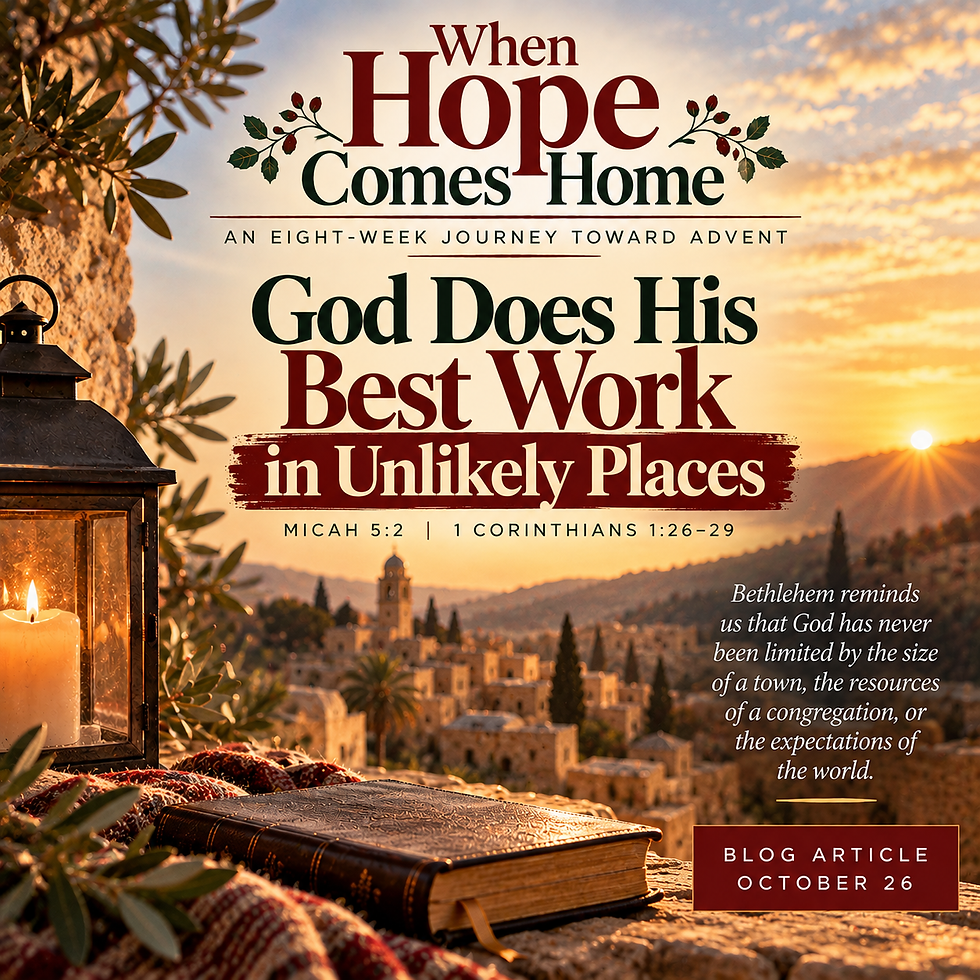
October 26, 2026 | When Hope Comes Home — An Eight-Week Journey Toward Advent
“But you, Bethlehem Ephrathah, though you are small among the clans of Judah, out of you will come for me one who will be ruler over Israel, whose origins are from of old, from ancient times.” — Micah 5:2 (NIV)
I've spent most of my pastoral ministry serving smaller churches, many of them in communities that most people couldn't find on a map without a little help. When people would ask me where I was from I’d just say Southern Ohio, because most likely they had never heard of the little village where I lived.
You know the kind of places I'm talking about.
Small towns where everybody knows everybody, and if they don't know you personally, they probably know someone who does. Places where the local diner is as much a gathering place as it is a restaurant. Communities where people still wave at passing cars, even when they aren't sure who's driving.
And tucked away in those communities are little churches.
Some have beautiful old sanctuaries with stained-glass windows. Others meet in simple buildings that don't look like much from the outside. Some have been serving their communities for generations, while others are still trying to find their place.
They don't have impressive budgets. They don't have a large staff. They probably don't have the latest technology or the kind of programs that make headlines in church leadership magazines.
But here's something I've come to believe with all my heart.
God has never been limited by the size of a church, the population of a town, or the resources available to His people.
In fact, when you read the Scriptures, you discover that God has a remarkable history of doing extraordinary things in the most unlikely places.
A Little Town Called Bethlehem
As we continue our journey toward Advent, I want to take you to a place that almost everyone recognizes today but few people would have considered important in the days of the prophet Micah.
Bethlehem.
Today, the name immediately brings to mind Christmas. We picture Mary and Joseph, the manger, the shepherds, and the angels announcing the birth of Christ.
But hundreds of years before Jesus was born, Bethlehem was hardly the kind of place anyone would have expected to become the center of God's redemptive story. It was just a Podunk town.
Jerusalem was the important city. It was the political and religious center of Judah. It had the temple, the royal history, and the influence.
Bethlehem was a small town a few miles away.
Yet God spoke through Micah and declared that from this seemingly insignificant place would come the ruler of Israel.
Think about that for a moment.
God could have chosen Jerusalem.
He could have arranged for the Messiah to be born in a palace surrounded by wealth, power, and influence.
Instead, He chose Bethlehem.
A small town.
An ordinary family.
A humble beginning.
And through that unlikely place, God would introduce the Savior of the world.
That ought to encourage every pastor serving a congregation that seems too small to make much of a difference.
Because Bethlehem reminds us that significance in God's Kingdom has never depended on prominence in the world's eyes.
God Has Always Worked This Way
When you look through the Bible, you'll discover that Bethlehem wasn't an exception.
It was part of a pattern.
God called Abraham and Sarah when their circumstances made the promise of a great nation seem impossible.
He called Moses, a reluctant leader who questioned his own ability to speak, to confront Pharaoh and lead His people out of Egypt.
He chose David, the youngest son of Jesse, a shepherd boy who wasn't even initially brought before Samuel when the prophet came looking for Israel's next king.
And when Jesus began His earthly ministry, He didn't recruit His disciples from the most influential religious institutions in Jerusalem.
He called fishermen, a tax collector, and other ordinary people to follow Him.
People who would eventually carry the Gospel throughout the world.
Paul understood this when he wrote to the Corinthians:
“Brothers and sisters, think of what you were when you were called. Not many of you were wise by human standards; not many were influential; not many were of noble birth.” — 1 Corinthians 1:26 (NIV)
Then he explained that God chose what the world considered foolish and weak to shame the wise and strong.
Why?
So that no one could boast before Him.
God delights in working through ordinary people because His power becomes unmistakable when the results cannot be explained by human ability alone.
That's not to say that God never uses large churches, gifted leaders, or abundant resources. Of course He does.
But it does mean that none of those things are prerequisites for His blessing.
And that's good news for the smaller church.
Stop Apologizing for Being Small
One of the things that concerns me when I work with smaller churches is how often pastors and congregations seem to apologize for their size.
You've probably heard it.
"We're just a little church."
"We don't have much to offer."
"We used to have a lot more people."
"We can't do what those bigger churches do."
Sometimes those statements are simply observations about reality. But sometimes they reveal something deeper.
We've allowed the world's definition of success to shape our understanding of what makes a church valuable.
We've started measuring our potential by what we don't have instead of recognizing what God has already placed in our hands.
I want to challenge that way of thinking.
Your church may be small, but that doesn't mean it's insignificant.
You may not have a large worship team, but you can worship God with sincerity and joy.
You may not have a dozen ministry programs, but you can build meaningful relationships with people in your community.
You may not have a large staff, but you can equip ordinary believers to live as disciples of Jesus in their homes, workplaces, and neighborhoods.
And you may not have hundreds of people attending on Sunday morning, but you can still make disciples who make disciples.
The Great Commission was never reserved for churches that reached a certain attendance threshold.
It belongs to all of us.
I sometimes wonder how many smaller congregations have become so preoccupied with what they lack that they've stopped recognizing what God has given them.
What if we stopped asking, "Why can't we be like that church?"
And started asking, "What has God uniquely equipped us to do right here?"
That question can change everything.
Finding Your Church's One Excellent Mission
When I coach churches seeking revitalization, one of the most important things we work on is discovering what I call their One Excellent Mission.
The idea is simple.
Rather than trying to imitate every program offered by a larger congregation, a smaller church can prayerfully discern where three things intersect:
The real needs of the community around them.
The gifts, passions, and abilities God has placed within the congregation.
The opportunities where they sense God's blessing and direction.
Somewhere in that intersection, a church may discover a focused mission through which it can make a meaningful difference.
For one congregation, that might mean building relationships with families who have children with disabilities.
For another, it might mean creating a place of belonging for older adults who are experiencing loneliness.
Another church might discover that God has uniquely equipped its members to mentor young families, support local schools, or reach people who have become disconnected from the Church.
None of those ministries requires a congregation of five hundred people.
They require a congregation willing to listen, discern, and respond faithfully to God's calling.
And here's something else.
A small church doesn't have to become a large church before it can become a healthy church.
Health begins when a congregation understands who it is, why it exists, and how God is calling it to participate in His mission.
Growth may follow. But even when numerical growth is slow, a congregation can still experience genuine spiritual vitality and make a lasting difference in its community.
Remember Bethlehem.
God didn't need the biggest city to accomplish His purpose.
He needed a place where His promise would be fulfilled.
Don't Overlook the Ordinary
There's another lesson in the story of Bethlehem that I don't want us to miss.
Sometimes we're so busy looking for God to do something spectacular that we overlook the extraordinary things He's already doing through ordinary people.
Think about the members of your congregation.
There's probably someone who quietly visits people who can no longer attend worship.
Someone who prepares meals when a family is going through a difficult season.
Someone who faithfully teaches a small Sunday school class, even when there are only three or four people in attendance.
Someone who takes time to listen to a neighbor who's struggling.
Someone who prays faithfully for people who may never know their name.
Those are powerful examples of incarnational ministry happening. Those things don't usually attract attention. They don't generate headlines or impressive social media statistics.
But they matter.
They matter to the people being loved.
They matter to the Kingdom of God.
And they matter to Jesus.
Remember what He said in Matthew 25 about caring for the hungry, the stranger, the sick, and those in need?
The King identifies Himself with those who are often overlooked.
Perhaps one of the greatest opportunities smaller churches have is their ability to notice people whom larger institutions sometimes struggle to see.
In a world where so many people feel invisible, a congregation that knows your name, remembers your story, and notices when you're missing can be a powerful witness to the love of Christ.
Don't underestimate that.
What If You're Exactly Where God Wants You?
Let me speak directly to the pastor who may be feeling discouraged today.
Perhaps you're serving in a town that seems to be shrinking.
Maybe your church has fewer people attending than it did ten years ago.
Perhaps you've looked at the resources available to your congregation and wondered how you could possibly accomplish anything significant.
I understand those feelings.
But I want you to consider something.
What if God has placed you in that community for a reason?
What if the relationships you're building, the people you're discipling, and the prayers you're praying are part of something you cannot fully see yet?
What if your congregation's greatest opportunity isn't becoming something bigger, but becoming more faithful to the mission God has entrusted to it?
Now, I'm not suggesting that every church should remain exactly as it is. Some congregations need to make difficult changes. Some need to rediscover their purpose. Others may need to let go of traditions and practices that no longer help them reach their communities.
But renewal doesn't begin with becoming impressive.
It begins with becoming obedient.
It begins when ordinary people in ordinary places decide to take God's extraordinary calling seriously.
And that can happen anywhere.
Even in a little town that most people have never heard of.
Advent Reminds Us Where Hope Begins
In just a few weeks, we'll begin the season of Advent.
We'll light candles, sing familiar hymns, and once again hear the story of a young couple traveling to Bethlehem.
We'll remember the shepherds watching their flocks and the angels announcing good news of great joy.
But I hope this year we'll see something more.
I hope we'll remember that God chose an unlikely place to reveal His extraordinary love.
He didn't wait until the circumstances were impressive.
He didn't require the approval of powerful people.
He didn't measure Bethlehem's potential by its population or resources.
He simply fulfilled His promise.
And in doing so, He reminded the world that His Kingdom operates according to a very different set of values.
Pastor, your church may never be famous.
Your name may never appear on a conference program.
Your congregation may never have the kind of resources that other churches enjoy.
But if you're faithfully proclaiming Christ, making disciples, loving your neighbors, and helping people discover the transforming grace of God, you're participating in something of eternal significance.
Because God doesn't need an impressive place to do extraordinary work. He needs people who are willing to trust Him and obey.
A Final Word of Encouragement
This week, I'd like to challenge you to look at your congregation through a different lens.
Instead of making a list of everything your church doesn't have, take a few minutes to identify three gifts God has already placed within your congregation.
Maybe it's a group of people who genuinely care for one another.
Maybe it's a building that's ideally located to serve a particular community need.
Maybe it's someone with a passion for children, older adults, or families who are struggling.
Then ask yourself this question:
How might God use what we already have to make a difference in the lives of people around us?
You may discover that the seeds of your church's future ministry have been sitting right in front of you all along.
Don't overlook them.
And don't underestimate what God can do with a congregation that is willing to offer Him what it has.
Join Me on the Journey Toward Advent
This is the third article in our eight-week series, When Hope Comes Home: Preparing Our Hearts for the God Who Comes Near.
Each Monday, we're exploring how God meets us in the ordinary and sometimes difficult seasons of life as we prepare our hearts for Advent and Christmas.
These reflections are also helping shape a new sixteen-day Advent devotional centered on hope, peace, joy, and love.
Next Monday, November 2, we'll explore "Making Room for What God Wants to Do." We'll look at Mary's willingness to surrender her plans to God's greater purpose and consider what our churches may need to release to make room for something new.
And I'd love to hear from you.
What's one unexpected way you've seen God work through a small church or an ordinary person?
Share your story in the comments. It might be exactly the encouragement another pastor needs today.
And if this article encouraged you, please share it with a pastor or church leader who needs a reminder that God still does extraordinary things in unlikely places.


Comments